
Royal College of Nursing-Last Shift Survey
Disturbing feedback from Nurses throughout the UK.

Introduction
Every two years the RCN undertakes a ‘Last Shift Survey’: a large-scale survey with RCN members on staffing levels which seeks to identify where there are issues, risks or areas where progress has been made. The survey was open for a period of 5 weeks between (2nd March and 7th April 2026) to all RCN members delivering direct patient care across the UK and in all health and care settings. Over 13,000 responses were received.
Results
Respondents were asked specifically whether there were enough registered nurses on duty to meet the needs of patients/service users safely and effectively.
64% reported that nurse staffing levels were below or well below what was needed.
44% of respondents reported that care was compromised on their last shift.
49% reported hospitals were the most likely place where care was compromised.
The most selected reason for care being compromised (by 7 in 10 (71%) of respondents) was ‘not enough registered nurses’.
22% said “care significantly compromised’ posing a ‘high risk of harm to patients and staff.”
76% of respondents reported feeling emotionally exhausted on their last shift.
Testimonies
‘Care’ has disappeared in nursing.’

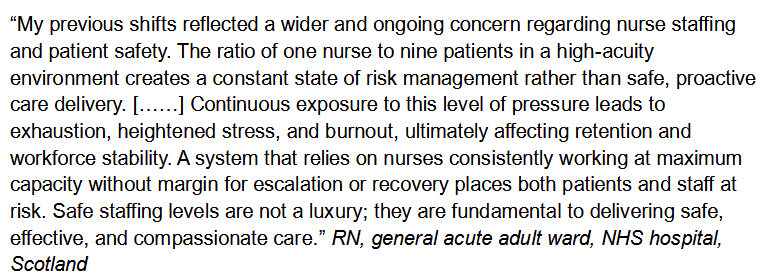
‘One nurse to nine patients..a constant state of risk.’
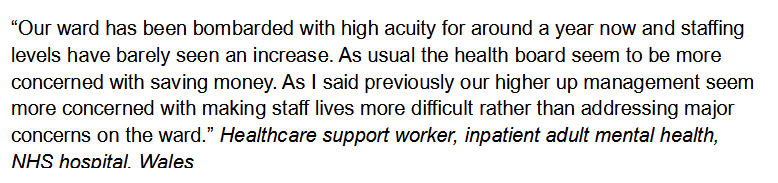
‘Management seem more concerned with making staff lives more difficult that addressing major concerns on the ward.’
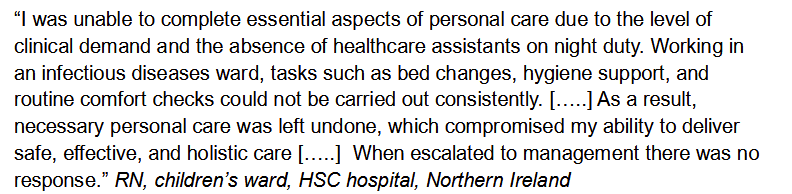
‘When escalated to management (inadequate care provision for children) there was no response.’
The report concludes (page 6) mentioning;
‘Nursing staff are leaving the profession in high numbers.’
RCN Scotland Executive Director, Colin Poolman, said;
“When NHS nursing staff in Scotland say there is a high risk of harm to patients because staffing is below what is needed, the government must act. Scotland’s population cannot afford for them to be complacent to rising, dangerously unmet levels of patient need.’’
“The continued gaps in the registered nurse workforce are always unsafe, but the risk is being compounded by the demands of delivering ever more complex care to an ageing, sicker population, with multiple conditions.”
Thanks for your attention.
All feedback welcome.
End